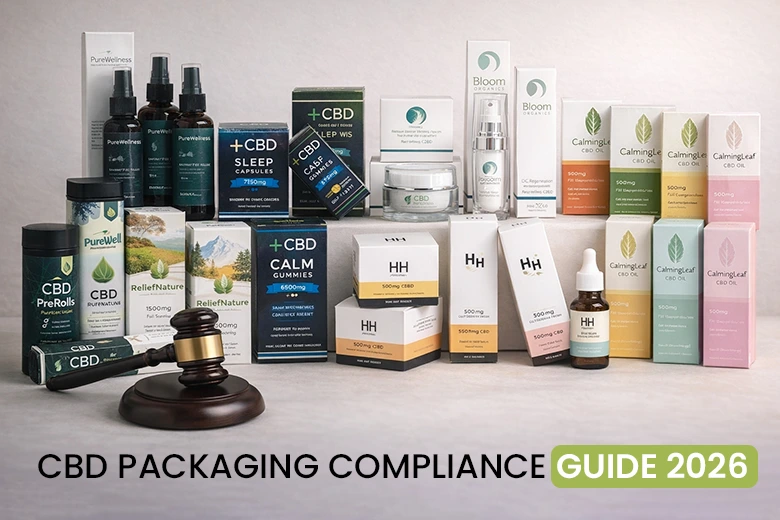
CBD packaging compliance in the United States is becoming more complex as federal, state, and enforcement priorities continue to evolve. In 2026, brands must navigate overlapping requirements from federal hemp definitions, FDA and FTC oversight, and state cannabis or hemp laws.
The key takeaway is that your CBD packaging, including boxes, bottles, labels, and inserts, should always be designed to meet the strictest laws where your product will be sold.
Throughout this guide, we break down how federal limits, child-resistant standards, labeling rules, and state-by-state variations affect CBD packaging decisions in 2026.
Understanding how these layers interact is essential for building packaging systems that remain compliant across multiple markets without constant redesign.
Federal THC Limits and Their Impact on CBD Packaging
The 0.4 mg Total THC Per Retail Container Rule
A major regulatory shift heading toward late 2026 is the proposed cap of 0.4 mg total THC per retail container for finished hemp-derived consumer products.
Why does this matter for packaging design?
- Retail container defines compliance: Regulators assess THC per immediate container, making package size and serving count part of compliance strategy.
- Label math must match lab results: Total THC calculations may include multiple cannabinoids, so labeling must align with COA data.
- Interstate distribution risks increase: Federal limits can affect multi-state SKUs even when local rules differ.
Brands should treat this as a packaging redesign opportunity, optimizing container sizes, refining potency panels, and creating modular label templates.
Federal vs State CBD Packaging Laws
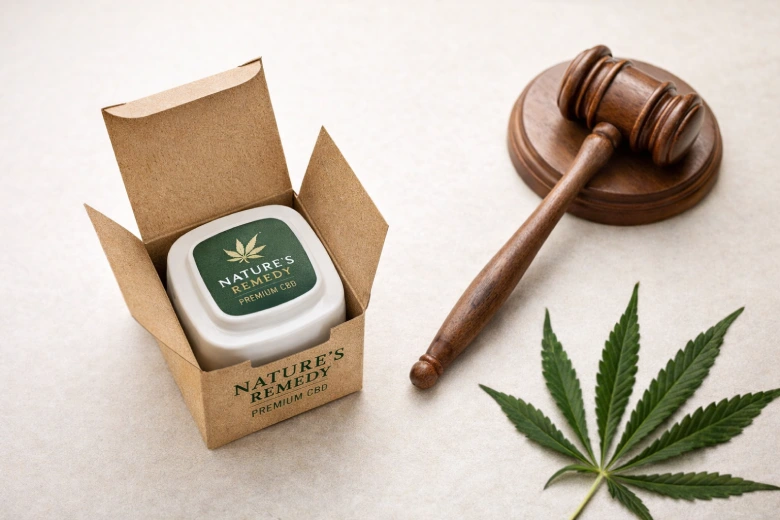
Federal oversight
At the federal level, CBD legality remains tied to hemp definitions and THC thresholds, while the FDA focuses primarily on misleading health claims and improper product positioning.
State regulatory frameworks
Most states operate under one of two systems:
- Hemp CBD programs: Focus on testing transparency, labeling basics, and contaminant limits.
- Cannabis programs: Often require child-resistant, tamper-evident, and warning-labeled packaging.
Since definitions vary, “legal CBD packaging” can mean different things depending on where the product is sold.
How Do CBD Packaging Regulations Differ by State?
CBD packaging regulations differ significantly across jurisdictions, making formal state-by-state verification a critical step before approving large production runs.
In California, regulations impose strict child-resistant packaging standards alongside product-specific labeling obligations.
Colorado maintains detailed statutory language governing packaging, including requirements related to opacity and mandated compliance statements.
New York’s framework references child-resistant packaging aligned with federal PPPA testing standards and requires operators to retain supporting compliance documentation.
In Florida, hemp extract rules mandate a scannable QR code or barcode linked to a certificate of analysis, in addition to batch identification, potency disclosure, and expiration dating.
Sustainable and PFAS-Free CBD Packaging Trends
Eco-friendly CBD packaging is no longer optional in many markets. Consumer demand and state regulations are driving a shift toward PFAS-free materials and sustainable packaging solutions, especially for ingestible CBD products.
States such as California, New York, and Washington have enacted restrictions on certain PFAS uses, making compliant material sourcing a growing priority for brands.
CBD Packaging Requirements by Sales Channel
Your packaging strategy should align with the strictest channel you sell through:
- DTC eCommerce: Highest scrutiny on claims and shipping labels
- Retail wellness stores: Expect transparency and sustainability proof
- Convenience and smoke shops: Enforcement often targets youth-appealing designs
- Licensed dispensaries: Require child-resistant and tamper-evident formats
CBD Labeling Requirements Checklist
Since CBD products are regulated differently depending on their format and the jurisdiction in which they are sold, labeling should be structured as a formal compliance framework rather than a marketing tool.
In most state hemp programs and retail compliance systems, packages are expected to:
- Clearly identify the product and its intended use.
- Display the net quantity of contents.
- Provide a complete ingredient declaration where applicable.
Labels should also disclose the total CBD or cannabinoid content consistent with laboratory results, list the name and address of the responsible party, and include traceability elements, such as a batch or lot number and an expiration date.
When required, access to a certificate of analysis (COA), typically provided through a QR code, must be included along with any mandated warnings related to age restrictions, safety, or conditions of use.
For a more detailed regulatory breakdown of labeling requirements, including format-specific rules and state variations, see: What Are CBD Labeling Requirements in the USA? (2026 Guide).
CBD Packaging Claims to Avoid
Improper product claims remain the primary driver of enforcement risk, particularly where marketing materials imply that CBD products diagnose, mitigate, treat, cure, or prevent disease, or otherwise function as drug substitutes. Regulators consistently scrutinize representations that convey therapeutic intent, whether express or implied.
Claim categories that cause higher risk include:
- Disease treatment, prevention, or symptom-relief statements.
- Comparative or substitution claims relative to approved drugs or therapies.
- Testimonials or endorsements framed as clinical or medical outcomes.
Safer marketing focuses on general wellness and factual, verifiable product details instead of suggesting medical benefits or proven treatment effects.
Child-Resistant CBD Packaging Standards
Child-resistant packaging is mandatory in most cannabis-regulated markets and increasingly expected for hemp-derived ingestibles.
The recognized testing standard is 16 CFR § 1700.20, part of the Poison Prevention Packaging Act.
Best practices
- Use certified child-resistant packaging formats
- Maintain compliance documentation
- Re-test if structural changes occur
Tamper-Evident CBD Packaging Requirements
Tamper-evident features are widely expected for ingestible CBD products and regulated channels.
Common solutions include induction seals, tear strips, shrink bands, and sealed inner pouches. Even when not explicitly required, they are often necessary for retailer acceptance.
Opaque Packaging Rules for CBD Edibles
Some jurisdictions require opaque or non-transparent packaging for edibles and restrict designs that may appeal to children. Brands selling nationwide often maintain a conservative “edibles-ready” packaging option to simplify compliance.
Risks of Non-Compliant CBD Packaging
Non-compliant CBD packaging can trigger a range of costly and disruptive consequences for brands. Products may be rejected by retailers or online marketplaces, preventing them from reaching customers.
In stricter jurisdictions, state regulators can impose enforcement actions such as product holds or stop-sale orders, while misleading labeling or claims may attract federal warning letters.
Beyond regulatory risks, businesses often face significant financial losses from reprints, relabeling, or unsellable inventory. For these reasons, integrating compliance into packaging design and production processes from the outset is almost always more efficient and cost-effective than making corrections later.
For a broader discussion of packaging strategy and compliance integration, read: Custom CBD Boxes And Packaging: Materials, Compliance, Printing, and Cost Guide.
How to Choose a CBD Packaging Supplier That Understands Compliance?
Working with a supplier experienced in regulatory packaging can significantly reduce risk. Providers offering specialized solutions, such as the custom options detailed by Pack Legacy, typically build compliance considerations into materials, structure, and documentation workflows.
What to look for in a CBD packaging partner
- Verified child-resistant certifications
- Experience with regulated cannabis or hemp markets
- Multi-state artwork template systems
- Material transparency and PFAS-free options
- Change-control processes
FAQs
Q1. Is CBD packaging regulated by the FDA?
FDA oversight mainly focuses on labeling and marketing claims rather than packaging structure alone.
Q2. Do CBD gummies need child-resistant packaging?
Often yes, especially in cannabis-regulated states or where hemp ingestibles fall under similar rules.
Q3. Can you put health claims on CBD packaging?
Disease-related or drug-like claims should be avoided to reduce enforcement risk.
Q4. Are QR codes required on CBD packaging?
Some states require them, while others treat them as best practice for transparency.
Q5. Are CBD packaging rules the same nationwide?
No. Requirements vary significantly by state and product category.