"The boxes arrived exactly as I imagined. The quality is great and the process was simple from start to finish."
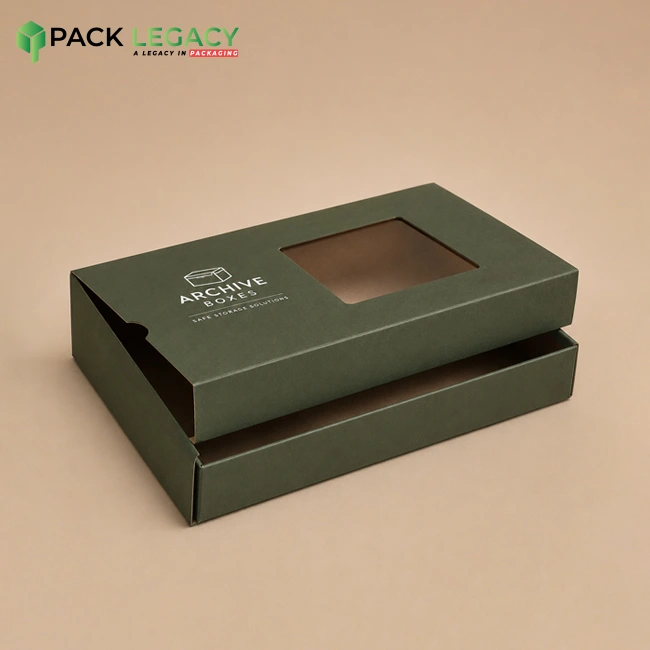
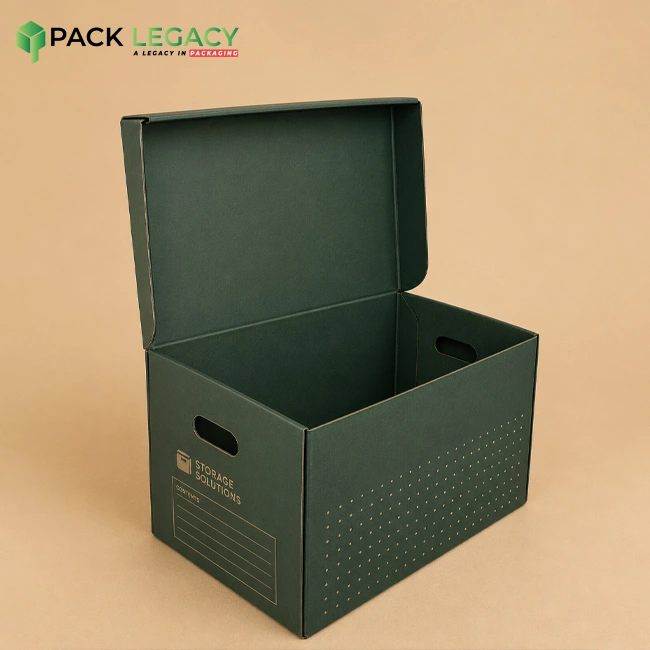
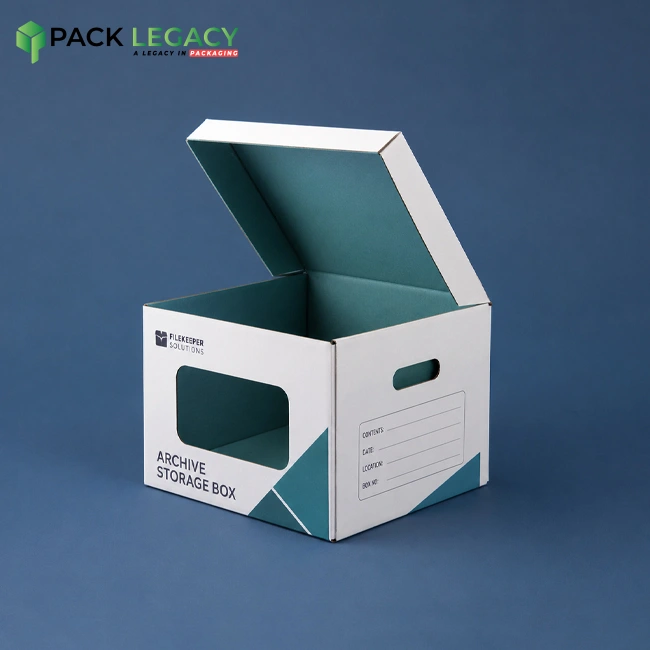
Custom archive boxes are sturdy storage containers designed to organize, protect, label, and transport documents, folders, photographs, books, records, and other important materials. Choose custom dimensions for letter-size, legal-size, A4, flat documents, or specialty collections, with removable lids, attached lids, handles, dividers, label panels, and reinforced walls.
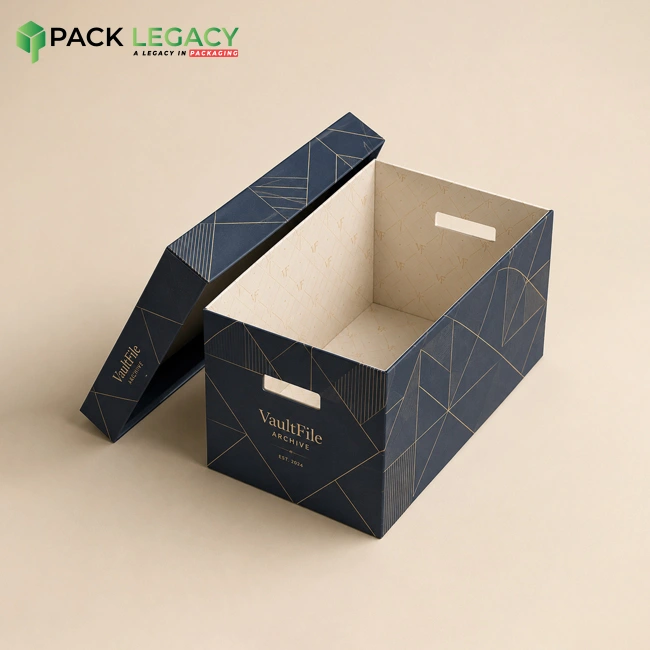
Personalize your archive boxes with company logos, department names, file numbers, barcodes, QR codes, review dates, and handling instructions. Select corrugated board, kraft, paperboard, or rigid stock according to your storage needs.
Order any quantity with free design assistance, digital proofing, wholesale pricing, and free shipping.
Custom archive boxes are durable storage containers manufactured to organize, protect, identify, and transport documents, folders, photographs, books, artwork, business records, and other stored materials. They help keep files grouped correctly while reducing exposure to dust, bending, surface wear, and handling damage.
Our archive storage boxes are suitable for offices, legal firms, accountancy companies, schools, healthcare organizations, government departments, libraries, museums, warehouses, real estate agencies, photographers, and private collections.
Although the terms “archive boxes” and “archival boxes” are frequently used together, they can describe different storage requirements.
Standard archive boxes are intended for organizing office records, legal documents, financial files, inventory information, school records, and general stored materials. They are commonly produced from corrugated cardboard, kraft board, or sturdy paperboard.
Preservation-grade boxes are intended for valuable photographs, historic documents, manuscripts, artwork, museum collections, and other materials requiring long-term care. Such projects may require verified specifications relating to acidity, lignin content, buffering, pH level, or photographic safety.
When preservation-grade storage is required, inform our team before requesting a quote. Material properties such as acid-free, lignin-free, buffered, or unbuffered construction must be confirmed according to your project rather than assumed from the word “archival.”
A properly sized archive box supports the contents without forcing documents into a tight space or allowing them to move excessively. Share the finished dimensions, quantity, orientation, and approximate weight of the stored materials so that the internal box size can be calculated accurately.
| Stored material | Common format | Recommended storage position | Available sizing |
|---|---|---|---|
| Office documents | Letter-size folders | Upright | Custom-fitted dimensions |
| Legal documents | Legal-size folders | Upright | Custom-fitted dimensions |
| International records | A4 files and folders | Upright or flat | Custom-fitted dimensions |
| Photographs and prints | 4 × 6, 5 × 7, 8 × 10, or custom | Flat or upright | Made according to collection size |
| Certificates and artwork | Standard or oversized | Flat | Made-to-measure |
| Books and journals | Varies by publication | Flat or upright | Custom-fitted dimensions |
| Small artifacts | Product-specific | Compartmentalized | Custom box with dividers |
Internal dimensions are especially important when the box must accommodate hanging folders, dividers, spacer boards, index cards, or several document categories.
Different box structures provide different levels of access, portability, stacking strength, and presentation. We can develop the structure according to how frequently the contents will be accessed and where the boxes will be stored.
Self-locking archive boxes use interlocking panels and can normally be assembled without glue or tape. They are commonly supplied flat to reduce storage space before use.
A drop-front construction allows one side of the box to open downward. This makes it easier to access horizontally stored photographs, prints, artwork, documents, and delicate materials without lifting them from the top.
Clamshell and rigid boxes provide a more refined structure for books, certificates, historical documents, premium portfolios, and presentation archives. Businesses requiring a premium appearance can also explore our custom presentation boxes and custom book boxes.
Built-in hand holes or reinforced handles make heavy office records easier to carry. Our custom handle boxes can be adapted for portable document storage when convenient handling is a priority.
For valuable or dust-sensitive collections, fully closed walls may be preferred over open handle holes.
The appropriate material depends on the weight of the contents, required stacking strength, expected storage period, transportation conditions, and preservation requirements. Visit our packaging materials guide to compare available stocks and finishing options.
Corrugated board is suitable for office files, bulk records, warehouse storage, document transportation, and stackable storage boxes. Reinforced walls or stronger flute grades can be considered for heavier contents.
Kraft board provides a natural appearance and is suitable for general document organization, office storage, and branded record boxes. Explore our custom kraft boxes for additional kraft packaging options.
Paperboard is suitable for lighter documents, small photographs, stationery, certificates, and compact record collections. It offers a smooth surface for detailed printing and identification labels.
Rigid greyboard provides a thicker and more premium structure. It is appropriate for executive records, valuable books, certificates, presentation portfolios, and collections that require a refined appearance.
When storing valuable photographs, historic documents, or museum materials, request verified preservation-related specifications. Material suitability should be confirmed according to the type of stored item and its intended storage period.
Archive boxes can include practical features that improve organization, handling, identification, and access.
Custom structural features can be developed through precision die-cut packaging according to the document size, access method, and storage system.
Custom printing can make archive boxes easier to identify, locate, track, and manage. Instead of using plain boxes with handwritten notes, you can add permanent printed fields for important record information.
Available printing details may include:
You can select one-color printing for practical identification or full-color CMYK and Pantone printing for branded archive boxes. Printing may be applied outside, inside, or on both sides depending on the structure.
Internal organization prevents different files, photographs, or record categories from becoming mixed. Dividers and partitions can create individual sections for departments, dates, clients, projects, or document types.
Spacer boards can be added when the stored documents do not completely fill the box. They help keep upright files supported and reduce unnecessary movement inside the packaging.
For photographs, artifacts, and delicate materials, custom inserts may be developed according to the dimensions and handling requirements of the collection.
The required board strength depends on the total filled weight, box dimensions, storage duration, and number of boxes being stacked. Large boxes are not automatically suitable for heavy records simply because they provide more internal space.
Provide the approximate filled weight and intended stacking arrangement when requesting a quote. Our packaging team can recommend an appropriate board grade, reinforced panel arrangement, or double-wall construction.
Avoid claims such as waterproof, crush-proof, or unlimited stacking unless the selected structure and material have been tested for those specific conditions. Paper-based archive boxes should be stored in a clean, dry environment away from water leaks, excessive humidity, and direct sunlight.
Most corrugated and folding archive boxes are supplied flat to reduce storage and shipping space. Self-locking panels allow them to be assembled without specialized tools.
Rigid, clamshell, and specialty preservation boxes may arrive pre-assembled depending on their structure. Your quotation and proof should clearly confirm the supplied format before production.
Accurate dimensions are essential for archive packaging. Request one of our free dieline templates to review the cutting, folding, lid, handle, label, and printing areas.
Our design team will provide a digital proof or 3D mockup before production. Review the dimensions, printed fields, barcode information, department names, storage dates, and handling instructions carefully before approval.
You can also request one of our custom packaging sample kits when you need to inspect the material, structure, dimensions, assembly, printing, or finishing before placing a larger order.
The cost of archive boxes depends on the complete project specifications rather than one fixed price. Important pricing factors include:
Provide complete measurements and storage requirements to receive an accurate quotation. Larger production quantities generally provide a lower per-unit cost, while reinforced structures and specialized materials may increase the price.
Pack Legacy manufactures archive boxes according to your document size, storage method, material, strength, structure, printing, and quantity requirements. Order plain storage boxes or add branded labels, record fields, handling instructions, barcodes, QR codes, dividers, handles, and reinforced panels.
Follow our simple custom box ordering process and provide the internal dimensions, stored material type, approximate filled weight, preferred box style, printing requirements, and order quantity. Our team will review your specifications and prepare a custom quote for your archive storage boxes.
Dimensions | All Custom Sizes & Shapes |
Material | Paperboard, Cardboard, Kraft, Corrugated, Rigid Stock |
Stock Thickness | 250 to 600 GSM (Paperboard/Cardboard) and 800 to 2000 GSM / 1mm to 3mm (Rigid Stock) |
Color Print | CMYK, Pantone (PMS) |
Printing Options | Inside, Outside, or Both |
Coating & Laminations | AQ Coating, UV Coating, Spot UV, Varnish, Lamination, Soft Touch, Anti-Scratch Lamination |
Finishing | Foil Stamping, Embossing/Debossing, Holographic Foiling, Raised UV, Textured Finishes |
Add-ons | Die-Cut Windows, Ribbons |
Inserts | EVA Foam Inserts, Die-Cut Dividers |
Production | 8 to 12 Business Days |
Shipping | Standard, Rush — Free Shipping |
We've answered all the common questions you may have before ordering custom boxes.
Archive boxes are used for general document storage. Archival-quality boxes use specially verified materials for long-term preservation.
The size depends on your document dimensions, folder type, quantity, and storage position. We can manufacture custom sizes for letter, legal, A4, photos, books, and artwork.
We offer corrugated cardboard, kraft board, paperboard, cardstock, and rigid greyboard. Preservation-grade materials are available upon request.
Most corrugated archive boxes arrive flat for easy storage. Rigid and specialty boxes may arrive assembled.
Weight capacity depends on the box size, material thickness, board strength, and construction. Reinforced options are available for heavier files.
Yes. You can request a sample and review a digital proof or 3D mockup before bulk production begins.